
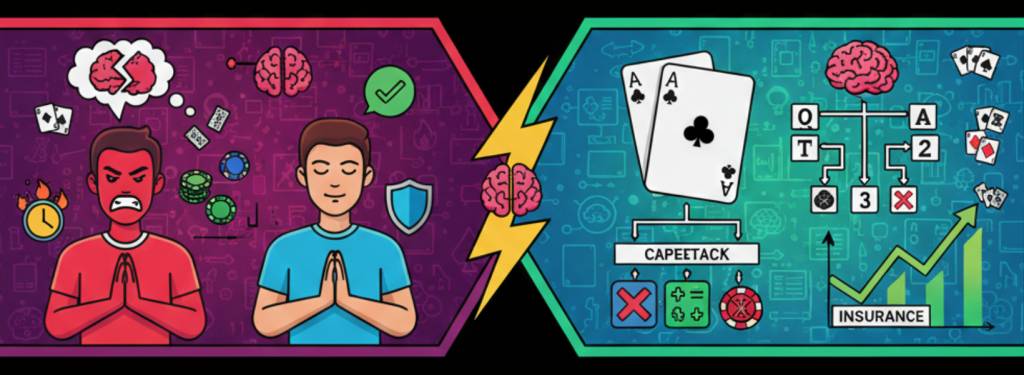
The Psychology of Blackjack: Emotional Discipline & Tilt Control
Blackjack is often presented as a mathematical game built on probability, strategy charts, and calculated decisions. Yet, anyone who has played for long enough knows that the psychology behind the game is just as important as the rules themselves. Understanding emotional discipline and tilt control is essential for players who want to maintain an edge, avoid costly mistakes, and enjoy the game responsibly.
Emotional discipline begins with recognising that short-term outcomes in blackjack can be unpredictable. Even when you follow perfect basic strategy, losing streaks can and will happen. Players who lack discipline often react impulsively: increasing bets out of frustration, abandoning strategy after a bad hand, or chasing losses in the hope of a quick recovery. This emotional decision-making erodes the mathematical advantage of solid play. Discipline means sticking to your game plan even when the cards feel unfair. It means managing your bankroll calmly and accepting variance as a natural part of blackjack.
Tilt control is a crucial part of this. “Tilt” describes the emotional spiral that occurs after a bad beat or series of losses, causing players to think irrationally. In blackjack, tilt can be triggered by anything from the dealer drawing a miracle 21 to misplaying a strong hand through frustration. Good players learn to recognise the early signs of tilt: tension, impatience, irritation, and the urge to bet bigger. When this happens, the best move is often to take a break step away from the table, reset, and return with a clear mind.
Ultimately, mastering the psychology of blackjack is about staying calm, balanced, and intentional. Emotional discipline keeps your gameplay sharp; tilt control protects you from unnecessary losses. Together, they form the mental foundation of a smarter, more enjoyable blackjack experience.
Understanding Blackjack Odds & Probability
Understanding blackjack odds and probability is essential for anyone who wants to move beyond guesswork and make informed, strategic decisions at the table. Unlike many casino games that rely purely on chance, blackjack allows players to influence outcomes through mathematically sound choices. To do that effectively, you must first understand how the house edge works and what the odds look like for the most common decisions you’ll make during play.
House Edge Explained
The house edge in blackjack reflects the mathematical advantage the casino holds over the long term. In a typical UK blackjack game with standard rules, the house edge usually ranges from 0.5% to 2%, depending on the number of decks, whether the dealer hits or stands on soft 17, and other table conditions. Importantly, this edge assumes the player uses basic strategy. Without strategy, the house edge can increase significantly in some cases reaching 3%–4%. The better your decision-making, the closer you stay to the lowest possible house edge.
Odds of Common Decisions
Every action you take carries a different probability of success. For example, hitting on a hard 12 against a dealer’s 2–3 has a better long-term expectation than standing, even though it feels risky. Similarly, doubling down on hard 10 or 11 produces some of the highest expected returns in blackjack, especially when the dealer is showing a weak card. Splitting aces is almost always statistically correct because it maximises the probability of forming strong two-card hands. Meanwhile, taking insurance is almost never favourable, as the odds heavily benefit the house.